 Deutsch
 English

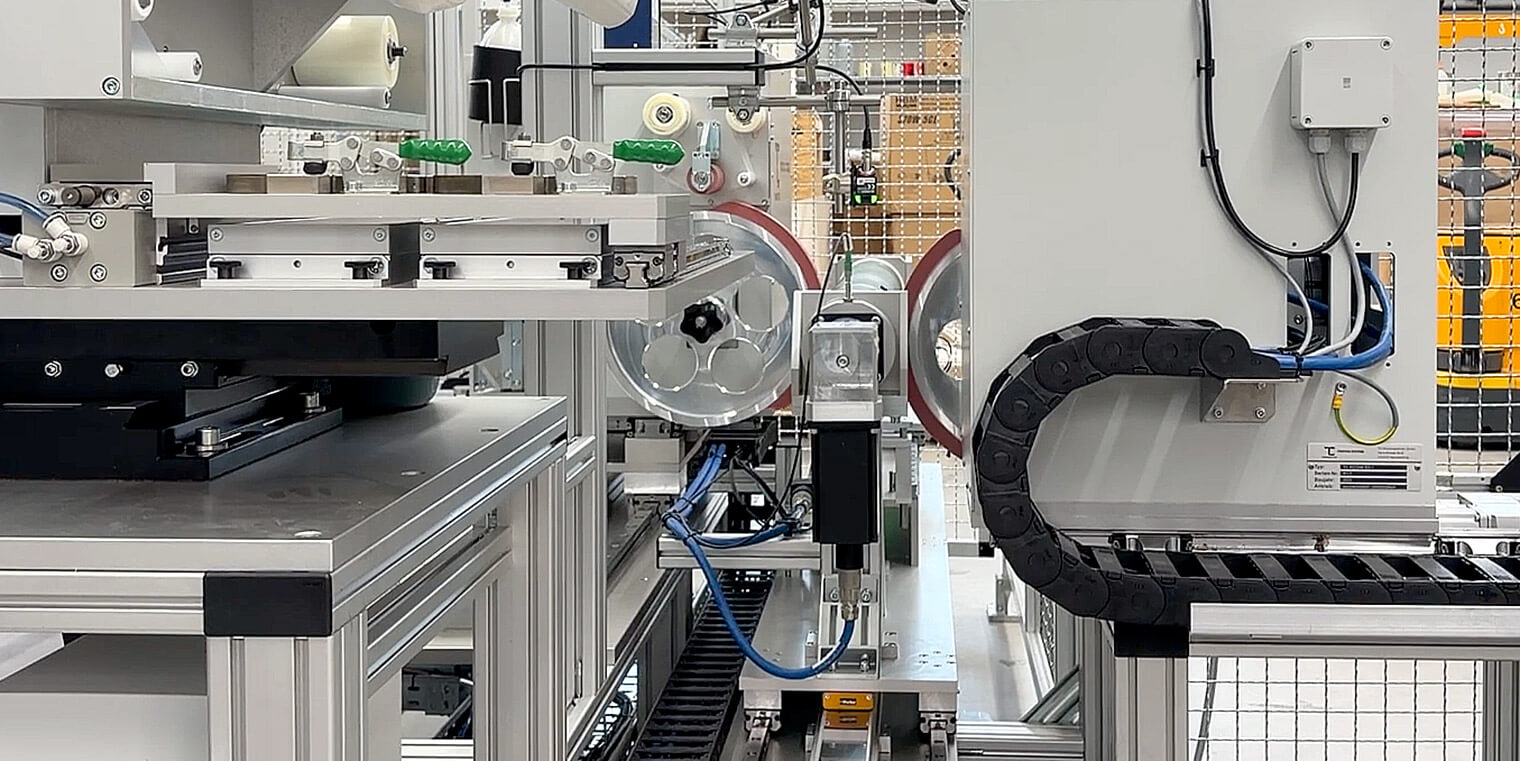
Rotary printing machines for circumferential and continuous printing
The TAMPONCOLOR ROTAM RD-1 prints circumferential motifs or markings on cylindrical and other suitable rotationally symmetrical components. The rotary printing machine works with a cliché roller and a pad roller instead of a flat printing plate and a single printing pad.
TAMPONCOLOR builds the ROTAM RD-1 to customer specifications and matches the printing process, drive and integration to your application.
- Servo-electric drives
- Print image length up to 314 mm
- 360° printing depending on application
- Built to customer specifications
How does rotary pad printing work?
In rotary pad printing, a cliché roller transfers the printing ink to an elastic pad roller. The pad roller releases the motif onto the substrate as it rolls over it. The process is suitable for circumferential print images on tubes and other rotationally symmetrical components. It can also be used for material that is fed continuously beneath the printing unit.
Whether a closed 360° print image is possible depends on the component diameter, the motif and the design of the pad roller. Depending on the printing task, TAMPONCOLOR uses a fully coated or a segmented pad roller.
ROTAM RD-1: technical data at a glance
| Model | TAMPONCOLOR ROTAM RD-1 |
| Design | Customised rotary printing machine |
| Cliché roller diameter | 100 mm |
| Maximum print image length | 314 mm (with a cliché roller diameter of 100 mm) |
| Cliché roller width | Up to 100 mm |
| Maximum print image width | Approx. 80 mm, depending on the pad roller |
| Number of colours | 1 colour per machine; an additional machine for each further colour |
| Standard cycle rate | 1,200 cycles per hour |
| Drives | Cliché roller, pad roller and pad cleaning servo-electric |
| 360° printing | Possible depending on the application |
| Cliché versions | Steel cliché roller or photopolymer cliché |
The values describe the ROTAM RD-1 and the standard configuration stated. Component dimensions, pad roller and speed are designed for the specific printing task.
Synchronised continuous printing: steel profile example
In an application that is already in operation, a ROTAM system prints a company logo on steel profiles directly in an existing forming line. The profile runs continuously beneath the machine during printing. In this project, a conveying speed of up to 12 metres per minute was achieved.
An encoder records the current conveying speed. Based on this, the system controller regulates the printer drives so that the pad does not slip over the profile during ink transfer. For this task, TAMPONCOLOR uses a segmented pad roller: the pad touches the profile only in the print area and then keeps a defined distance. This avoids unwanted contact with the component.
Printing in the running line
The system prints the steel profile directly in the existing forming line.
Controlled printer drives
An encoder records the conveying speed and the controller adjusts the drives accordingly.
Segmented pad roller
The pad touches the profile only in the print area and then keeps its distance.
Further applications and suitable materials
In addition to continuous printing on profiles, rotary printing is suitable, for example, for circumferential markings on tube surfaces. Which geometries and materials can be printed depends on the surface, the required ink adhesion and the print image. In principle, many materials that are also used in conventional pad printing are suitable, including metals and plastics.
Integration into existing production lines
TAMPONCOLOR can design the ROTAM RD-1 as a stand-alone printing workstation or as part of an automated production line. Depending on the application, workpieces can be supplied and removed via handling components, robot systems, magazines or combined feeding systems. Conveyor technology, component guidance and printing movement are matched to one another.
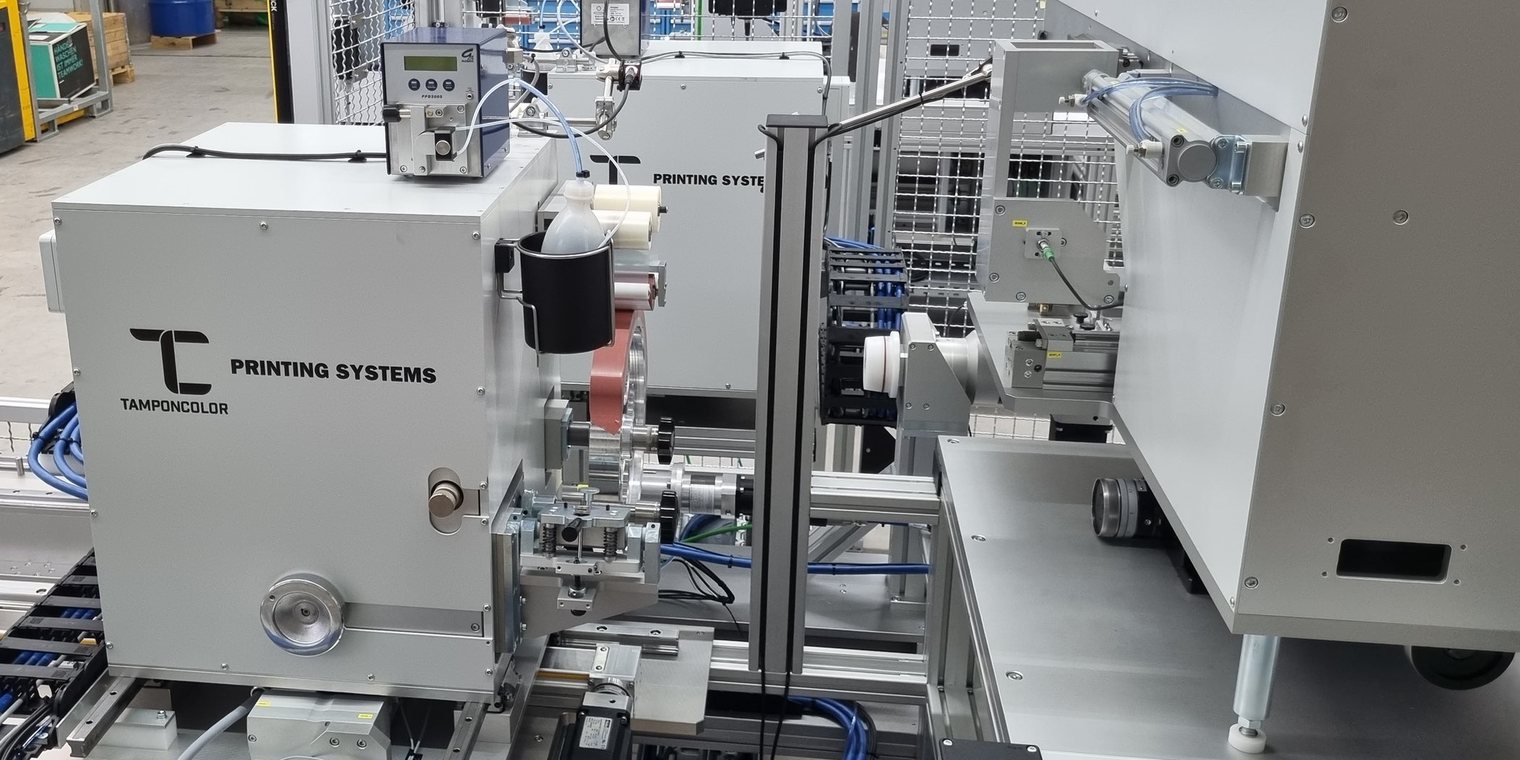
For successive multi-colour prints, a further printing machine is used for each additional colour. These process steps are coordinated as part of the individual system concept.
Frequently asked questions about rotary printing machines
With a cliché roller diameter of 100 mm, print image lengths of up to 314 mm are possible. The print image width is up to around 80 mm and depends on the pad roller used.
Circumferential 360° printing is possible depending on the application. Decisive factors include the component diameter, the print image and the design of the pad roller.
The ROTAM RD-1 prints in one colour. A further machine is required for each additional colour.
Yes. TAMPONCOLOR designs feeding, positioning, printing movement and removal individually. In one completed project, the printing process was synchronised with a running forming line.
Any questions about printing pads, clichés, inks or pre-treatment? The pad printing glossary explains the most important technical terms.
Plan a rotary printing machine for your application
Would you like to print a tube, a profile or another rotationally symmetrical component? Send us the component dimensions, the material, the desired print motif and information about your production process.
Together we will clarify whether the ROTAM RD-1 is suitable for your printing process and how the machine can be integrated.
Phone: +49 (0) 6102 7954-0 · Email: