 Deutsch
 English

Pad Printing Glossary: Technical Terms Explained
What is a cliché? How do conventional and rotary pad printing processes differ? When does a plastic surface need pre-treatment? This glossary explains key terms relating to printing machines, printing inks, clichés, automation and industrial applications.
The entries are in alphabetical order. Where relevant, links lead to machines, accessories and industry solutions from TAMPONCOLOR.
A
Automatic pad cleaning
In fully automatic pad cleaning, the printing pad is passed over a cleaning tape at defined intervals to remove ink deposits. This can support the stability of the print image in series operation and reduce manual cleaning. The cleaning cycles are matched to the printing process. On the ROTAM RD-1, the pad cleaning drive is also servo-electric.
Automation in pad printing
Automation in pad printing means integrating the printing process into semi-automatic or fully automatic production sequences. Handling systems, robots, rotary indexing tables or linear transfer systems feed, position and pass on the components. Depending on the application, pre-treatment, drying and print image inspection are also integrated. This reduces manual intervention, makes sequences reproducible and allows high volumes to be processed with consistent quality. Precise coordination of the individual process steps is essential.
B
Biocompatibility
Biocompatibility describes the biological compatibility of a material in its intended contact with the human body. For medical devices used in this way, printing inks and other constituents of the finished product must also be assessed on a risk basis. The ISO 10993 series of standards provides an important framework for evaluation; the requirements depend on the specific product and its intended body contact.
C
Cleanroom
A cleanroom is a production environment in which airborne particles are controlled under defined, verified conditions. Cleanrooms are classified according to relevant standards such as ISO 14644. Pad printing machines can be adapted in design for such production areas. However, suitability for a particular cleanroom class must be assessed on the basis of the specific machine concept and corresponding evidence; a clean production area is not automatically a classified cleanroom.
Cliché
The cliché is the printing plate used in pad printing. The print motif is a recess that holds ink and releases it to the printing pad. For TAMPONCOLOR’s current accessories range, photopolymer and thick steel clichés are particularly relevant. Which version is suitable depends on the motif, run length, ink system and print image requirements. Both types of cliché are processed or produced at TAMPONCOLOR.
Cliché production
In cliché production, the print motif is created as a printing recess in the printing plate. For steel clichés this is done by etching, for photopolymer clichés by exposure followed by washing out. TAMPONCOLOR etches steel clichés and exposes photopolymer clichés in-house. The design depends on the motif, ink film, run length and the requirements of the printing process.
Cliché roller
The cliché roller is the cylindrical printing plate of a rotary printing machine. In the rotary ink transfer process, the motif is transferred to the workpiece via a pad roller. TAMPONCOLOR offers steel cliché rollers as well as versions for photopolymer clichés. Which variant makes sense depends on the motif, run length and the customised rotary printing process.
Closed ink system
In a closed ink system, the ink cup and its doctor ring form a largely sealed ink and doctoring unit. Compared with the open system, this gives the ink greater protection against evaporation and contamination. The ink cup size must be matched to the cliché and the print motif.
Coding cliché
A coding cliché, also known as a sliding cliché, makes it possible to print changing numbers or codes in combination with a fixed print image. Movable, ground cliché strips are combined with a fixed cliché section. One area of use is the marking of serial numbers or batch codes directly in the printing process.
Component handling
Component handling covers picking up, aligning, transporting and depositing workpieces between the individual process stations. Depending on the component, grippers, robots, vacuum cups or transfer systems are used. The handling system must present the print position reproducibly.
Component marking
Component marking means applying information to technical components so that it is permanent or durable enough for the application. Examples include type designations, scales, serial numbers, function markings and safety notices. Pad printing is particularly suitable for marking three-dimensional, curved or textured surfaces. The requirements for legibility, positioning accuracy and durability depend on the area of use. In automated production processes, marking tasks can be combined with further processing and inspection steps.
Contamination
Contamination is the unwanted soiling of a component or production area, for example by particles, ink residues or lubricant residues. In sensitive applications, potential sources can be reduced by adapted machine design, choice of materials, cleaning procedures and process control. Which measures are required depends on the requirements of the production environment.
Corona treatment
In corona treatment, a controlled electrical discharge modifies the surface of certain plastics and so improves their wettability with printing ink. The process is often used for materials with low surface energy. As a guide, TAMPONCOLOR cites 40–44 mN/m after treatment. Whether this range is sufficient depends on the material, the ink and the specific application.
Cycle time
The cycle time is the duration of a complete machine or system sequence. In automated pad printing, depending on the process, it includes feeding, positioning, ink transfer, cleaning where applicable, drying and removal. The possible output of a system is derived from the cycle time, taking into account parallel operations, available stations and downtime.
D
Doctor blade
The doctor blade is the component that, in an open ink system, wipes excess ink off the cliché so that only the recesses of the motif remain filled with ink. Correct setting of the doctor blade, neither too high nor too low, is crucial for clean print results.
E
Edge definition
Edge definition describes how precisely the edges of a printed line or area are reproduced. Cliché quality, ink rheology, pad shape and hardness, as well as printing force and deformation, influence the result. A pad that is deformed too much can distort the motif.
Electromechanical drive
An electromechanical drive generates the machine movement by means of an electric motor and a mechanical transmission, for example cam discs. At TAMPONCOLOR, such designs are used for high-speed machines, among others. Cycle rate and printing force depend on the model.
Etch depth
The etch depth is the depth of the printing recesses in an etched steel cliché. It influences how much ink the cliché holds and how the print image is transferred. For common applications, TAMPONCOLOR gives a guide value of around 23–25 µm. The right value depends on the motif, the ink system and the process conditions.
F
Feasibility test
In a feasibility test, TAMPONCOLOR assesses whether a specific component can be reliably marked or decorated by pad printing. The assessment is based on material, surface condition, geometry, print motif, quantity and the requirements for durability and process control. An original component may be needed for reliable trials.
Flame treatment
Flame treatment is a thermal process for pre-treating plastic surfaces with low surface tension, in particular polyolefins such as PP and PE. Brief contact with an open flame oxidises the molecules near the surface, which raises the surface tension and makes ink adhesion possible. Corona treatment is used as an alternative to flame treatment.
Flash-off time
The flash-off time is the adjustable period between ink pick-up from the cliché and ink transfer to the workpiece. During this phase, part of the solvent evaporates, which changes the transfer behaviour of the ink. The appropriate time depends on the ink, the environment and the printing task.
I
In-mould printing
In in-mould printing, a print motif is applied to the cavity surface of an injection mould and transferred to the plastic component during injection moulding. This integrates printing into the manufacturing process. TAMPONCOLOR has developed its own printing system for this, which can transfer metallic, sinterable pastes as well as printing inks. Whether the process is suitable depends on the mould, the material and the process.
Ink adhesion
Ink adhesion describes how durably a printing ink film bonds to the surface of a component. It depends, among other things, on the material, the surface condition, the ink system chosen and the pre-treatment. Plastics with low surface energy in particular may require additional treatment. The adhesion required depends on the later stresses, for example abrasion, moisture, temperature changes or contact with chemicals. Suitable test methods help to verify the durability of the print image.
Ink cup
In a closed ink system, an ink cup serves as both ink reservoir and doctoring unit. Its doctor ring wipes excess ink off the cliché. Ink cup diameter, cliché format and motif size must match. TAMPONCOLOR’s range includes the TC-FT and SMART CUP TC-FTS systems.
Ink viscosity
Ink viscosity describes the flow properties of the pad printing ink and is a key parameter for the print result. Ink that is too thick cannot be picked up completely from the cliché recesses by the pad; ink that is too thin is squashed on the substrate and produces blurred contours. Viscosity is adjusted by adding thinner and depends on the print image, the operating conditions and the operator’s experience.
Inline integration
Inline integration means that the printing station becomes part of an existing production line. Interfaces, cycle times, workpiece transport, control system and safety concept must be matched to the higher-level system. Individual TAMPONCOLOR machines and system solutions are designed for such integration.
L
Long-term durability
Long-term durability is the ability of a print image to remain legible and functional throughout its intended service life. Depending on the application, abrasion, moisture, temperature changes, UV light or chemicals play a role. Ink, substrate, pre-treatment and printing process must be matched to these requirements. In sensitive applications, the durability tests actually required must be specified separately; they are not carried out automatically by the machine manufacturer.
M
Machine adjustment
Machine adjustment is the precise fine-tuning of the pad printing machine after set-up. It includes centring the pad on the print image, setting the pad stroke onto the cliché and the product, and positioning the workpiece in the workpiece holder. Adjustment requires experience and is carried out in jog mode.
Multi-colour printing and multi-colour machines
In multi-colour printing, several colours are transferred to a component one after another. Register accuracy is crucial here: the individual print images must be positioned exactly in relation to each other. Depending on requirements, several printing stations, a shuttle device or specially developed multi-colour printing systems are used. Industrial multi-colour printing is used, for example, for logos, scales, control elements and decorative surfaces. Precise coordination of ink application, pad movement and component positioning ensures consistent print quality.
O
One-component ink (1K ink)
A one-component ink is processed without a chemically reacting two-component hardener. Depending on the ink system, suitable thinners or other additives are added. The film often forms physically through evaporation of solvents; suitability depends on the material and the resistance required.
Open ink system
In an open ink system, the cliché, ink tray and doctor blade mechanism are exposed. After inking, excess ink is removed by a doctor blade. The system is suitable for larger print formats, among other uses; ink viscosity and evaporation need particular attention during operation.
P
Pad geometry
Pad geometry describes the shape, curvature and dimensions of the printing pad. It influences how the pad contacts the cliché, rolls onto the component and transfers the motif. A suitable shape helps to avoid air entrapment and distortion of the print image.
Pad printing
Pad printing, also known as tampo printing, is an indirect gravure printing process for printing three-dimensional components. The print motif is a recess in a printing plate, known as the cliché. An elastic silicone pad picks up the ink from the cliché and transfers it to the substrate. Because the pad is deformable, curved, textured and hard-to-reach surfaces can also be printed precisely. The process is used for technical markings, scales, functional prints and decorative print images.
Pad printing ink
Pad printing inks are formulated for ink transfer via an elastic printing pad. Their composition depends on the material, the print image and later stresses. Depending on the task, one- or two-component inks are used together with suitable thinners and additives. TAMPONCOLOR supplies suitable printing inks as merchandise under its own brand and matches the selection to the printing process concerned.
Pad printing machine
A pad printing machine transfers print motifs from a printing plate to the component to be printed by means of an elastic silicone pad. The process is particularly suitable for flat, curved and textured surfaces. Industrial pad printing machines differ, among other things, in their drive technology, printing force, print image size and degree of automation. Depending on the application, pneumatic, electromechanical or servo-electric machines are used. They can be used as stand-alone workstations or integrated into automated production systems.
Pad printing system (system solution)
A pad printing system combines one or more pad printing machines with additional components to form a production solution matched to the printing task. This can include component feeding, positioning, pre-treatment, printing, drying, quality inspection and removal. Such systems are particularly suitable for automated series processes with high requirements for cycle rate, repeat accuracy and process reliability. The design depends on component geometry, material, print image, quantity and the existing production conditions.
Pad stroke
The pad stroke is the movement or travel of the pad as it is set down on the cliché and the substrate. The stroke influences its deformation but is not identical to the actual printing force. Both quantities must be matched to the pad, motif and component in order to obtain complete print images with sharp contours.
Pad support block
A pad support block connects the printing pad to the machine and allows it to be positioned precisely. TAMPONCOLOR offers adjustable support blocks as well as magnetic retaining rings for fast pad changes with anti-rotation protection.
Pharmaline
Pharmaline is TAMPONCOLOR’s machine line for pharmaceutical and medical technology applications. Its design features include antistatic surfaces, stainless steel components and solutions that make cleaning easier. Workpiece holders and system layout are matched to the production concerned. Documentation, qualification support and requirements for the production environment are defined with the customer on a project basis; this does not constitute a blanket commitment to a particular cleanroom class.
Photopolymer cliché
A photopolymer cliché has a light-sensitive layer in which the motif is produced by exposure and washing out. It is particularly suitable for changing motifs and short to medium runs. The service life achievable depends, among other things, on the print image, the ink and machine operation. TAMPONCOLOR exposes photopolymer clichés in-house and supplies finished printing plates for the application concerned.
Photovoltaic metallisation
In photovoltaic metallisation, conductive pastes are applied to delicate silicon wafers. TAMPONCOLOR has realised applications for this with precisely controlled printing stations, automated handling and print image inspection. The aim is gentle and reproducible processing. A specific breakage rate or performance gain cannot be derived in general from this information; such values must be substantiated for each project.
Plasma pre-treatment
Plasma pre-treatment selectively modifies the near-surface structure of a material and can improve wettability and the adhesion of the printing ink. It is used in particular for plastics that are difficult to print. TAMPONCOLOR describes it in automated printing systems for plastics.
Pneumatic drive
A pneumatic drive uses compressed air to move individual machine axes. Pneumatic TAMPONCOLOR machines have a modular design and can be integrated into automated systems. Printing force, precision and cycle rate depend on the design concerned; statements on explosion protection require a separate suitability assessment.
Portal printing system
A portal printing system moves printing units or workpieces to different print positions via programmable axes. It allows flexible arrangements of print images and can combine several ink systems with variable part transport concepts. The TC Portalprinter is the corresponding TAMPONCOLOR system solution.
Pre-treatment
Pre-treatment covers processes that prepare the surface of a component for reliable printing. Depending on the material, flame, corona or plasma treatment may be considered. The aim is to improve wettability and ink adhesion or to reduce disruptive surface effects. TAMPONCOLOR can integrate these processes into customised systems; the choice is based on material, ink and printing requirements.
Print image inspection
In print image inspection, the finished motif is checked for defined characteristics such as position, completeness, alignment or visible print defects. The check can be carried out manually or by image processing with vision sensors. In customised TAMPONCOLOR systems, alignment and print image inspection can be integrated into automated sequences; inspection characteristics and tolerances depend on the application.
Print image size
The print image size describes the dimensions of the motif to be transferred to the workpiece. It influences the choice of cliché, ink cup, pad and machine. The maximum possible print image size depends on the model and is not the same as the cliché size.
Printed electronics and direct RFID printing
Printed electronics means applying electrically functional structures, such as conductive patterns or RFID antennas, by means of printing processes. Direct printing can replace additional labels or carrier materials. TAMPONCOLOR has realised RFID and electronics applications in several publicly funded projects. According to the company, suitable machine concepts are ready for the market and are adapted to the specific customer task.
Printing force
The printing force is the force with which the pad acts on the component during printing. It is influenced by the drive, pad geometry, pad hardness and motion control. Printing force and pad stroke are different quantities: a longer stroke does not automatically mean a particular force. Both parameters must suit the printing task in order to achieve a clear print image without excessive deformation.
Printing pad
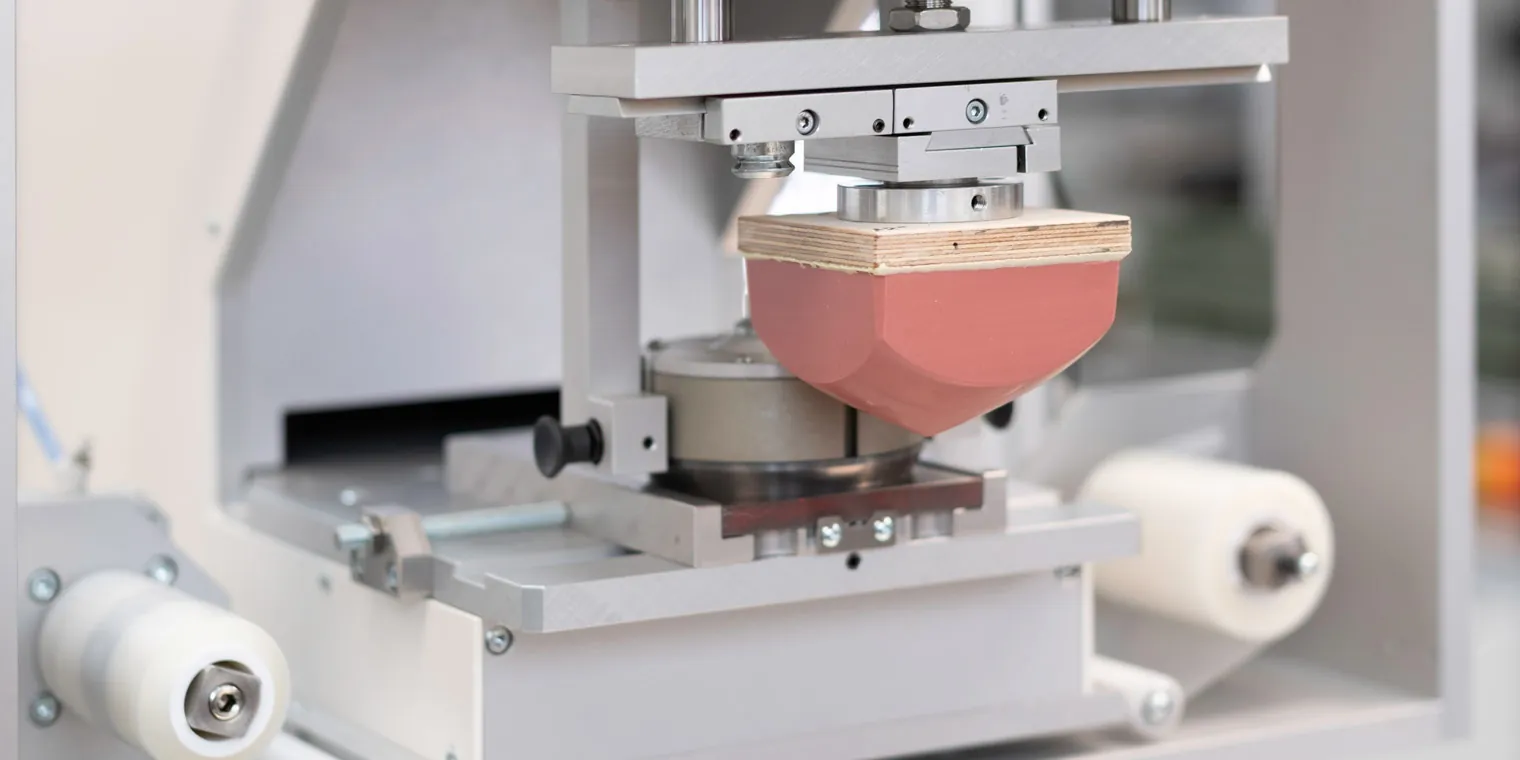
The printing pad is the elastic transfer element in pad printing. It picks up the ink from the cliché and transfers it to the component. Its shape, size and hardness are matched to the surface and the motif. This makes it possible to print curved or textured components as well. TAMPONCOLOR manufactures its silicone pads in-house and can adapt them to special printing tasks.
Process development
Process development means systematically matching all the variables of a printing task to one another: material, surface, ink, cliché, pad, machine, pre-treatment and drying. The aim is a reproducible sequence that meets the requirements of later series production.
Process documentation
Process documentation comprises the data defined and recorded for a printing process, such as machine parameters, settings and test results. It supports traceability and may be required for regulated production environments. TAMPONCOLOR can document machine parameters; the scope and further functions, such as traceability or qualification documents, are agreed with the customer for special-purpose machines.
Process validation
Process validation provides documented evidence that a manufacturing process repeatedly achieves the required results under defined conditions. In pad printing processes, print image position, ink adhesion and reproducibility may be relevant, for example. In regulated industries, the type and scope of qualification, for example IQ, OQ and PQ, are defined for each project. TAMPONCOLOR supports such requirements for customised systems by agreement; this does not imply a blanket validation.
R
Register accuracy
Register accuracy is how closely the positions of several print images or ink layers match one another. It is particularly important in multi-colour printing. The result depends on the workpiece holder, positioning, machine movement and pad deformation.
Repeat accuracy
Repeat accuracy describes how precisely a machine reaches a defined position or movement again under comparable conditions. In pad printing, it influences the position of the print image over many cycles. The actual accuracy depends on the machine, component holder and process and is not identical for all systems. In individual TAMPONCOLOR applications, ± 0.05 mm has been specified, for example.
Rotary indexing table
A rotary indexing table transports workpieces step by step from station to station. Feeding, pre-treatment, printing, drying and removal can be combined in this way, for example. The number of stations and the cycle sequence depend on the system task.
Rotary printing machine
A rotary printing machine transfers print motifs to moving or rotationally symmetrical components using a cliché roller and a pad roller. The process is suitable for circumferential markings and for printing in continuous material flow. The customised TAMPONCOLOR ROTAM RD-1 prints in one colour, with servo-electric drives for the cliché roller, pad roller and pad cleaning. TAMPONCOLOR cites 1,200 cycles per hour as the standard value; in an integrated steel profile application, the movement was matched to a conveying speed of up to 12 m/min. The print image and 360° circumferential printing depend on the roller and component geometry concerned.
S
Screen printing (compared with pad printing)
In screen printing, ink is transferred directly to the surface through the open areas of a fine-mesh screen. In pad printing, by contrast, an elastic pad picks up the motif from a cliché and transfers it indirectly to the component. This makes pad printing particularly suitable for many three-dimensional and curved surfaces. TAMPONCOLOR explains screen printing here solely as a comparison process; screen printing machines are no longer part of the current product range.
Screening
Screening breaks up areas of the print motif into small elements. In the cliché, it can help to control the amount of ink and achieve an even print image for larger motifs. The type and feasibility of screening depend on the cliché type and production method.
Servo-electric drive
In servo-electric pad printing machines, selected motion axes are driven by servo motors. This allows speed, position and motion sequence to be programmed precisely and matched to the printing task. The printing pad can, for example, be brought up to the component quickly and then set down in a controlled manner. Servo-electric drives are particularly suitable for demanding print images, different component geometries and processes with high requirements for repeat accuracy.
Set-up
Set-up covers preparing or changing over a machine for a specific print job. This includes fitting the cliché and pad, providing the ink and adapting the workpiece holder. The subsequent machine adjustment serves to set the printing parameters precisely. An initial connection of utilities, by contrast, is not required at every set-up.
Set-up time
The set-up time is the time needed to change a pad printing machine over from one print job to the next. Short set-up times are a key productivity factor in multi-shift operation and where products change frequently. TAMPONCOLOR specifically optimises set-up time in system solutions for pharmaceutical customers.
Shore A hardness
Shore A hardness describes the indentation hardness of elastic materials, for example silicone printing pads. The suitable hardness depends on pad shape, motif and surface geometry. Softer pads can deform more; harder pads can support sharp contours under suitable conditions. Generally valid hardness values cannot be specified without reference to the pad system used.
Solvent
Alongside binder and pigment, solvent is a basic constituent of pad printing inks. It makes the binder printable and controls the ink viscosity. Ink transfer in pad printing is based on evaporation of the solvent: as it evaporates, the adhesive forces change, so that the ink first adheres to the pad and then to the substrate.
Surface energy and wettability
The surface energy of a material influences how well a printing ink wets its surface. For plastics such as polypropylene or polyethylene, it can be too low for reliable ink adhesion. Flame, corona or plasma treatment can activate the surface. As a practical guide, TAMPONCOLOR confirms a range of around 40–44 mN/m; however, the value needed depends on the material, ink system and test.
T
Test ink
Test inks help to estimate the wettability of a surface. The surface tension indicated is expressed in mN/m; the result depends on the test method and the surface condition. A successful test is no substitute for testing the actual ink adhesion.
Thick steel cliché
A thick steel cliché is a hardened, precision-machined steel plate into which the print motif is etched. A common version is around 10 mm thick. Clichés of this kind are particularly suitable for long runs and reproducible print results. TAMPONCOLOR etches steel clichés in-house and matches the design to the motif, ink and production requirements.
Thinner
A thinner is used to adjust the processing viscosity and drying behaviour of a pad printing ink. Fast and slow thinners suit different process conditions. With chemically reacting two-component inks, adding more thinner does not automatically extend the specified pot life.
Tilting-head machine
A tilting-head machine has a swivelling print head. This allows the pad to pick up the ink at the cliché and then print a component that is positioned to the side or is difficult to access. The tilting movement extends the range of possible print positions. TAMPONCOLOR describes a corresponding version among its pneumatic pad printing machines.
Traceability
Traceability means that key information about a manufacturing process can be assigned to a product or batch. Depending on the application, this may include machine parameters, batch information and test results. Which data a pad printing system provides for this must be agreed and technically implemented for the production system concerned. TAMPONCOLOR offers customised solutions and coordination for this.
Two-component ink (2K ink)
A two-component ink consists of an ink component and a hardener, which are mixed in the prescribed ratio before printing. Depending on the product, thinner is also added. Chemical cross-linking can produce resistant ink films. Pot life, adhesion and the pre-treatment required depend on the product and substrate; with PP and PE in particular, pre-treatment is often still necessary.
Type plate
A type plate contains key information about a technical product, for example manufacturer, type designation, serial number or ratings. Depending on the component and requirements, such information can be applied directly to suitable surfaces by pad printing. Whether the print meets the applicable marking and durability requirements must be checked for the specific application.
W
Wet-on-wet printing
In wet-on-wet printing, several ink applications follow one another before the previous layers have dried completely. This can reduce intermediate times, but requires inks, ink films and printing parameters that are matched to each other. Which motifs and materials are suitable must be checked for the process concerned.
Workpiece holder
A workpiece holder positions and fixes the component for printing. The shape, material and position of the print area determine its design. Mechanical, vacuum-based or individually developed holders allow reproducible print positions. TAMPONCOLOR develops customised workpiece holders and, where required, combines them with rotary indexing tables, transfer systems or handling components.
Which printing process suits your component?
Would you like to know which printing process is suitable for your component? Talk to us about material, component geometry, print image and planned quantities. Together we will clarify the next steps for your application.
Phone: +49 (0) 6102 7954-0 · Email: